

Jesus went throughout Galilee, teaching in their synagogues, preaching the good news of the kingdom, and healing every disease and sickness among the people. Matthew 4:23
Jesus visits a Synagogue

Reconstruction of a first century synagogue - Nazareth Village, Israel
The gospels of the New testament record Jesus teaching / preaching in synagogues around Israel (Matthew 4:23, 6:2, 10:17 & 13:54), and Acts tells of Paul doing the same.
But where did synagogues come from and where did they fit into the system of the Jewish religion?
Jewish religious life, since the Exodus, as we read about it in the Hebrew scriptures (OT) centred on the Tabernacle and later the Temple in Jerusalem. Jewish people would go up to Jerusalem for the Moedim (appointed times) and for this reason they were known as the regalim (involving feet - walking - pilgrimage)
This set me wondering about religious life between the Moedim and the seven yearly reading of the Torah. Presumably teaching and study happened in the home, as instructed in the Shema. Deut 6:6
These words, which I am ordering you today, are to be on your heart; and you are to teach them carefully to your children. You are to talk about them when you sit at home, when you are traveling on the road, when you lie down and when you get up.
Also, what was happening in Jesus' time. I am grateful to Sam Gorenshten and Mike Feuer for tackling my questions.
The name, "synagogue" is from a Greek word and today a synagogue will be referred to in Hebrew as a biet knesset - house of meeting.
It seems synagogues were not mentioned in the Hebrew scriptures, to acquire a Hebrew name. Or maybe synagogue is just a word that stuck in the Greek in translation from Greek manuscripts.
Thanks to Sam Gorensten Israel Tour Guide for the information I have drawn from here.
As long as the Holy Temple existed religious ceremonies were only held only there. Today, the 'Cohanim' & 'Levites' have no official duties. They are waiting for the 3rd Holy Temple to be built. After the destruction of the 2nd Holy Temple, the 24 families of the 'Cohanim' were exiled from Jerusalem to Galilee where they gathered communities around themselves.
The 1st Synagogue, which we know of, was built in Babylon (Mesopotamia), after the destruction of the 1st Holy Temple 586 BCE. After the 2nd Holy Temple was built by Ezra & Nehemiah, when people returned from the diaspora in Babylon, they began building synagogues and in those days, they used the Synagogues as a meeting place or a place to study the Torah. Initially, the synagogue was a place for the community to gather (in Hebrew a "Bet-Knesset" meaning a house of gathering) like a town hall.
Back then, the houses were very small and the only place that could host a big celebration, such as weddings, bar-mitzvahs, or town hall meetings was the synagogue - the biggest building in the village. During this period, religious ceremonies were only held in the Holy Temple in Jerusalem. The recreated synagogue in Nazareth Village pictured above (where Jesus taught and prophesized) is typical. Only after the destruction of the 2nd Holy Temple did the synagogues begin to function as a "small temple" and hold religious ceremonies, but not sacrifices & offerings, as was the common practice in the Temple.
An interesting note: upon receiving their lands from Joshua son of Nun, the tribes of Israel began offering sacrifices in their villages to worship God. In later years of the King's period, local sacrifice on the "high places" had become mixed with pagan worship and Hezekiah and Isaiah ordered the destruction of these altars and that only the Holy Temple be used for religious ceremonies and sacrifices. Prayer is always made facing Jerusalem, so for the synagogues in the North that is facing south.
In the 2nd Holy Temple period, the main entrance/exit was from the south so the Galilee synagogues followed this pattern and also built the entrance/exit in the south.
This meant that the praying direction and the entrance/exit were all facing southward. This unique architecture is called the "Galilee Type" Synagogues
Synagogues built after the destruction of the 2nd Holy Temple were used as the main venue for religious ceremonies and were called it "Mikdash Me'at" - a small temple. Architectural features give one the look and feel of entering the Holy Temple. This excellent video about the recently excavated Magdala Synagogue is very interesting. Perhaps the workings of the early church developed from the synagogue; since the early church was just a new strain of Jewish faith. It appears that synagogues were governed locally by a group of elders in a kind of democracy, and teaching or preaching could be given by suitable members of the community or by itinerant teachers, so
there was, clearly, a system of authority or accreditation for teachers, and Jesus was challenged about his authority. Matthew 21 23 On this authority, JNTC explains Ezra 8:15 I assembled them by the river that runs to Ahava, and we camped there three days. I reviewed the people and the cohanim but found no L'vi'im there.
Jesus entered the temple courts, and, while he was teaching, the chief priests and the elders of the people came to him. "By what authority are you doing these things?" they asked. "And who gave you this authority?"
Hebrew s'mikhah, rendering Greek exousia "authority") means leaning or laying on of hands in the ordination ceremony for a judge, elder or rabbi. Laying on of hands is, in the Tanakh,
a symbolic act that confers or transfers an office, along with its duties and privileges, by dramatizing God's bestowal of the blessings and giftings needed for the work. In Judaism the practice is traced back to Moses' ordination of Joshua and of the seventy elders.
The Levites (L'vi'im)
In the parcelling out of land by tribe, we learn that the Levites did not receive allocations like the other tribes (num 18:21), as God was their portion. But Levites were to live in various towns throughout the land.
Did they function as outreach workers from the Temple system? Did they teach regularly in the synagogues? The Bible does not tell us.
I felt ignorant not to know this and consulted Rabbi Mike Feuer, who teaches on Jewish history (the excellent audio series, The Jewish Story)
I have been looking for someone to ask this. I hope you don't mind me asking you. Reading the Christian Bible (Hebrew scriptures and New Testament) we see Jewish worship as being Temple based, but then in the first century there are synagogues too, and Jesus taught in them. Were there synagogues (biet knesset (?)) all along. And were they run by the cohenim that we read of living in the rest of the land; and not just Jerusalem?Hi Michael -
As for your question about synagogues. Archaeologists have been pushing back the dates for the earliest synagogue for sometime. The mishna says that in the time of the 1st Temple the whole country was divided into 24 areas called ma'amadot. Each week one ma'amad would travel to Jerusalem to serve as the people's representative for the daily communal offering. They would pray and recite sections from Genesis. Even after the Temple was destroyed, some continued this practice in the synagogue, and this may have been its precursor.Rav Mike
So it seems that I was not alone in seeking to understand the origin of the synagogue.
See torahlab.org/community/article/synagogue/
These are the verses that caused me to wonder about the Levites
Deuteronomy 10:9 This is why Levi has no share or inheritance with his brothers; Adonai is his inheritance, as Adonai your God had said to him.
Deuteronomy 12:12 and you will rejoice in the presence of Adonai your God-you, your sons and daughters, your male and female slaves and the Levi staying with you, inasmuch as he has no share or inheritance with you.
Deuteronomy 12:18 No, you are to eat these in the presence of Adonai your God in the place Adonai your God will choose-you and your sons, daughters, male and female slaves, and the Levi who is your guest; and you are to rejoice before Adonai your God in everything you undertake to do.
Deuteronomy 12:19 As long as you are living on your property, take care not to abandon the Levi.
Deuteronomy 14:27 "But don't neglect the Levi staying with you, because he has no share or inheritance like yours.
Deuteronomy 14:29 Then the Levi, because he has no share or inheritance like yours, along with the foreigner, the orphan and the widow living in your towns, will come, eat and be satisfied-so that Adonai your God will bless you in everything your hands produce.
Deuteronomy 18:1 The cohanim, who are L'vi'im, and indeed the whole tribe of Levi, is not to have a share or an inheritance with Isra'el. Instead, their support will come from the food offered by fire to Adonai and from whatever else becomes his.
Joshua 14:4 The descendants of Yosef constituted two tribes, M'nasheh and Efrayim; and they gave no portion of the land to the L'vi'im except cities to live in, with the open land surrounding them for their livestock and crops.
A Visit to a Synagogue
Synagogues vary enormously in architectural style and religious practice.
The following photographs show some of the common features of a synagogue.
This synagogue resembles a free church chapel as it was once a Methodist church.

At the front there is no altar, but there is an Ark where the Torah scrolls are kept.
The decorations do not have representations of living creatures, only objects representing the
Holy Days.

Notice the two tablets of the ten commandments.

The lessons are read from the Bimah.

Above the Ark is a light called the Ner Tamid which always burns as a symbol of God's presence. It also represents the pillar of fire that guided the Jewish people on their early journey.

The Torah scrolls are kept in the Ark, behind a curtain that is decorated with the banners of the tribes of Israel.
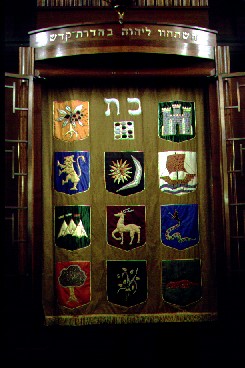
Behind the curtain are the Torah scrolls in their cases, or soft covers. The scrolls are said to be "dressed".

The scrolls are decorated with items that recall the role of the priests in the Temple.

The Breast piece.
The Rimmonim. (Rimmonim means pomegranates. The high Priest's robe was trimmed with pomegranates and bells)

With thanks to our friends at the Reform Synagogue in Cardiff, for their warm welcome and informative tour.
updated 23/11/22
Click the banner below to go to the site map and choose another page